Awestriking
I recently visited the Casts Gallery in the National Museum of French Monuments, across the river from the Eiffel Tower, the latter of which I assume you’ve heard of. In the 1870s and 1880s the architect Eugène Viollet-le-Duc had plaster casts created from some of France’s most famous cathedrals and monuments -- the doorways of the Basilica of Sainte-Marie-Madeleine in Vézelay and of Notre-Dame-du-Port in Clermont-Ferrand, along with several statues from the cathedrals in Chartres, Reims and Paris. (Fun fact: M. Viollet-le-Duc worked with Gustave Eiffel on his tower’s structural design, and we can thank Viollet-le-Duc for choosing copper as the metal for the statue’s skin, without which choice we would not be enjoying its beautiful copper oxide patina.)
Although the interwebs claim that these casts “contributed to enhancing public appreciation of medieval architecture and sculpture at a time when the art of Gothic cathedrals was still disregarded by the Académie des Beaux-Arts”, the gallery’s audio guide said that they were created to enable people who couldn’t readily travel far and wide to experience full size, accurately detailed portals and doorways and statues first hand. I had the thought that these plaster casts were kind of social media snapshots of the day (even though photography had already been invented by then, and perhaps fittingly by a French inventor, Nicéphore Niépce). The creation and transport of these casts was a monumental task, about as dissimilar from pointing and clicking a smartphone and posting on Instagram. Progress!!
Seeing all these casts, and later strolling past the newly restored Notre-Dame cathedral, I got to thinking about how much work was entailed in creating these things. It took 97 years to build the original Notre-Dame, likely requiring over a thousand artisans, carpenters, architects, and other workers. It took 120 years to build St. Peter's Basilica in Rome. It took 600 years to build the Cologne Cathedral, although, to be fair, construction stopped for a while when the money ran out.
These days we take a picture of the collard greens sandwich at Superiority Burger as readily as we do of the Eiffel Tower. And virtually anyone on the internet can see and comment on these photos immediately. This represents a kind of leveling of the significance of stuff and experiences – anything and everything is simultaneously both worthy and worth maybe only a fleeting doom scroll. (Unless you get, say, 90 million views. Now we’re talking!) But seriously, it would seem that this is some kind of untended consequence of the much-lauded democratization of creation and access that the internet and its companion tools not only have promised but truly delivered.
I harbor an almost certainly incorrect and misleading image – that of thousands of villagers, living simply at best and in squalor at worst, toiling away for decades in the service of creating a monument to, well, in many cases, their religious faith. My undoubtedly misconceived picture imagines that these folks didn’t mind the long hours, that the majesty and grandeur of their creation made it worthwhile. It represented something bigger than them, uplifting, inspiring, long-lasting, having a spiritual connection that gave their lives meaning etc etc etc.
Art fueled by religious passion is a powerful thing. The gospel music that has inspired and undergirded much of the greatest American popular music is one such example. The fact that an atheist like me is thrilled by creations that have been inspired by religious passion says something about something. To make great art requires you to be turned on by something, and religion certainly can do it.
I was raised in the Southern Baptist church. My recollection is that while, in every church service the hymns and the sermon varied from week to week, in every church service the congregation sang, together and a cappella and in unison, a short hymn called The Doxology. I always liked it. It was short and elegant, with a stately melody and a simple message of praise. As I have mentioned in passing, I’m not religious, but The Doxology has stuck with me all these years. While I’m in a middle of a kind of re-evaluation of my musical goals, I have recorded a version of it (click the image to listen):
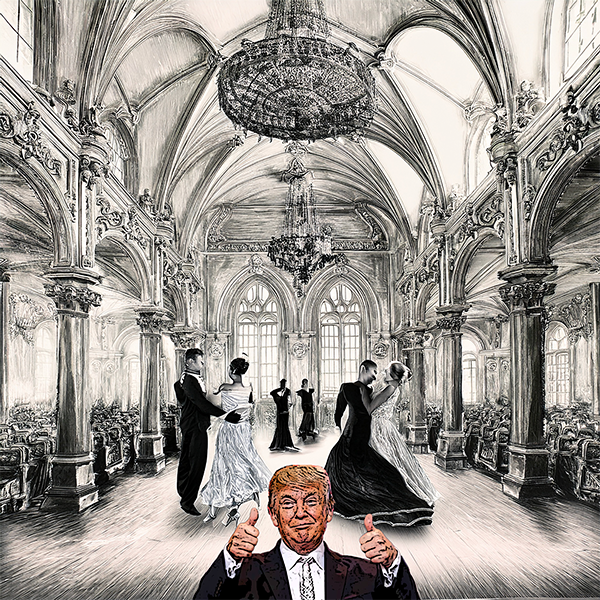
What are the lasting creations that we will be leaving to inspire (or at least impress) future generations? What are our great cathedrals? Huge repositories of social media postings? Supertall skyscrapers? The internet? Wait, I think I know: the new White House Ballroom!! Whew, I was worried there for a second.
Thanks for listening.